
Robert Hoiness: A Conversation on Clinical Genomics Careers

Updated: Apr 30
A Conversation on Clinical Genomics Careers
Written by Austin Esparza, CSULB Biotechnology Club
Speaker Info
What does Ambry Genetics do?
Ambry Genetics is a CAP-accredited, CLIA-certified clinical diagnostic laboratory that performs genetic testing for hereditary cancer predisposition, cardiac conditions, and rare genetic disorders. Orders come in from physicians and institutions, not directly from patients. The lab never sees a patient; it only sees their specimen. What it sends back is a report that the ordering physician or a genetic counselor then discusses with them.

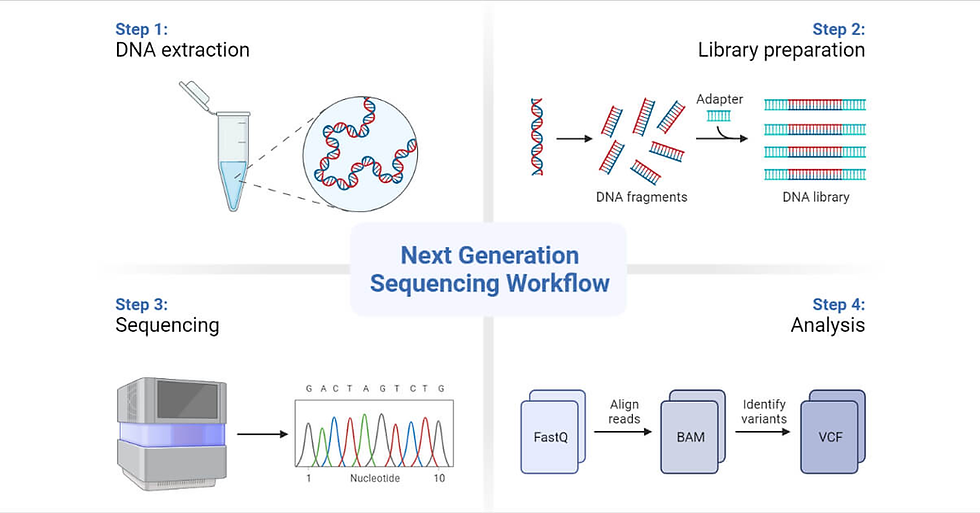
Samples arrive as blood or saliva, are accessioned into the laboratory information management system, and undergo DNA or RNA isolation, depending on the test. From there, they enter next-generation sequencing, where the lab processes approximately 1,500 patients at a time, followed by bioinformatics analysis. Anything requiring follow-up, such as verifying a variant or filling in regions of low sequencing coverage, is sent for Sanger sequencing, and a separate team handles the detection of large chromosomal duplications and deletions using a different technology entirely. All of that feeds into a reporting team that generates the final clinical report. Hoiness oversees five managers, each responsible for one stage of that process.
How has Robert's Career Developed?
He completed his undergraduate degree in Microbiology at CSULB and stayed to complete a master’s in Biology in the Judy Breslin lab. During graduate school, he held a clinical research coordinator role at the VA Medical Center in Long Beach and, concurrently, a laboratory technician position at the Veterinary Diagnostics Institute in Irvine. After finishing his master’s, he returned to the VA as a research assistant, a period he described with some candor: he had hoped the VA would be the answer, and it was not, though the experience turned out to be useful in retrospect. Hoiness turned to Ambry in 2010, where he took an initial pay cut, though eventually, he worked his way through CLS specialist licensing and climbed the career ladder during the next decade and a half.
He came to Ambry because the company offered an internal pathway to obtain a Clinical Genetic Molecular Biologist Scientist license, a California clinical laboratory specialty credential. He joined as laboratory support, which is the entry point for those who do not yet hold a license, since California requires licensure to perform clinical laboratory testing on patient samples independently. Once selected for the training course, he earned his C-GMBS credential and began advancing within the company.
He first managed next-generation sequencing assays, then moved into research and development, where he validated tests to move them from R&D into the regulated clinical environment in compliance with CAP and CLIA standards. The gap between development and clinical deployment has been a persistent challenge for diagnostic companies, and he worked specifically to close it. From there, he moved into pharma services, supporting pharmaceutical companies running clinical trials that used Ambry’s testing, before eventually taking on his current role as a director overseeing laboratory operations broadly.
What that progression shows is that a career in clinical genomics can span research and development, validation, pharma partnerships, and laboratory management without ever leaving one organization, and that depth within a regulated environment is worth building deliberately.
What should students know about the C-GMBS licensure pathway?
California separates the generalist Clinical Laboratory Scientist license from a set of limited specialty licenses. The C-GMBS, which stands for Clinical Genetic Molecular Biologist Scientist, is one of those specialty credentials, authorizing the holder to perform high-complexity molecular testing for the detection of human genetic disorders in CLIA-certified laboratories. Ambry is currently listed by the California Department of Public Health, Laboratory Field Services, as an approved C-GMBS training site.

At Ambry, the pathway into that credential starts with employment, not with an application to the course. Someone joins as a laboratory associate, handles operational and technical support work, and spends roughly 6 months to 1 year in that role before becoming eligible for selection into the training program. At that point, they apply to the state for a C-GMBS trainee license, which authorizes them to work on patient samples under the direct supervision of licensed CLSs and is valid only within state-approved programs. California explicitly states that unlicensed research experience, academic laboratory work, biotech, pharma, forensic, and veterinary roles do not count toward clinical licensure, which is an important distinction for students from research-heavy backgrounds.
During the training year, trainees rotate through different parts of the laboratory workflow, spending a set number of weeks in each area: isolation, NGS, accessioning, and others. They are processing patient samples throughout, under heavy supervision, and are paid for the full duration. Hoiness noted that pay increases when someone enters trainee status, though not yet to the full CLS rate. The program at Ambry currently runs from October to October. After completing the course, the trainee sits for the ASCP Technologist in Molecular Biology examination, which California recognizes as the approved certifying exam for the full C-GMBS license, and then submits for licensure with the state.

Two things Hoiness raised are worth knowing before pursuing this route. Some companies attach a contract to the training, requiring employees to stay for a set period after obtaining their license or to repay a portion of the training cost. He advised asking about this early, but to frame this question from a place of curiosity. Additionally, Ambry’s program is not open to external candidates; entry is only after a period of employment as a laboratory associate, which can occur through direct hiring or a staffing agency.
What does the work environment looks like at Ambry?
The part of the clinical lab environment that students from research settings are often least prepared for is the documentation. In a research lab, a failed experiment is a data point. In a clinical lab, a failed or uncertain result must be documented, reviewed, and resolved in a defined way before the specimen can move forward, usually through a quality event report (QER) that laboratory directors with specialized licensure can review and sign off on.
Hoiness was direct about what accountability requires of new employees: consistent communication. If something looks wrong, you need to communicate this to your team rather than try to resolve it quietly. The training process is designed to support new people through that adjustment, and there is always a supervisor, a lead, or a laboratory director available, but knowing when to speak up is itself a skill, and one that matters more in this environment than in most research settings.
He described his own management approach the same way: open, direct, and oriented toward surfacing problems early. In a lab processing thousands of patient samples, identifying an issue downstream is considerably more costly than catching it at the source.
What is the difference between a generalist and specialist license?
When a student asked about the difference between the generalist CLS license and the C-GMBS specialty license, Hoiness framed it as a choice between flexibility and focus. The generalist license opens more settings because it is not restricted to one type of laboratory, and the pathway to it typically runs through an accredited CLS training program affiliated with an academic medical center or university. The C-GMBS route, by contrast, is narrower in scope but well suited to someone whose interest is specifically in clinical genomics and molecular diagnostics, and the employer-based pathway through a company like Ambry is one way into it.
He also noted that CLS-level roles at Ambry are primarily bench-based, centered on working with patient samples, running assays, and producing accurate results. Hybrid roles that blend bench work with data analysis exist in some settings, but at Ambry, the positions are laboratory operations roles, which is worth factoring in if you are weighing different types of clinical genomics work against each other.
What advice do you have for students?
On building lab experience for CLS program applications, Hoiness suggested internships at clinical labs, research facilities, and the VA hospital. He also mentioned that some labs work with staffing agencies that regularly place laboratory associates, such as the case at Ambry, a route worth exploring if direct entry has been difficult.
Beyond the logistics, a few themes ran through the conversation. Knowing when to escalate a problem rather than engage in independent problem-solving. Clear communication with management, along with accurate benchwork, is part of what makes someone functional and successful in a clinical lab. Robert’s career has also reflected how staying with one organization for a long time allows one to build specialized expertise and advance in a corporate structure. Perhaps some of these opportunities are unique to Ambry, but it is up to you, dear reader, to be the architect of your own future and discover for yourself.
Further Reading and Resources
Licensure and Regulatory Info
California CDPH: C-GMBS Trainee License, C-GMBS License, and Approved CLS Training Programs
ASCP Technologist in Molecular Biology (MB) Certification
About Ambry Genetics
Ambry Genetics
Ambry Genetics Careers


Comments